Query Monet’s greatest masterpiece from Google, and, Impressionist, Sunrise and Nymphéas (Water Lilies) will undoubtedly emerge among the returned results. Yet, Monet’s true magnum opus remains absent. The subsequent article is dedicated to unveiling this masterpiece.
The movement of impressionism found definition in the lavender haze of Impressionist, Sunrise when Louis Leroy — a critic and opponent of the movement — remarked, “Impression; I was certain of it. I was just thinking that as I was impressed, there had to be some impression in it. And what freedom! What ease of handling! A preliminary drawing for a wallpaper pattern is more highly finished than this landscape!”
The comment, sparked as an insult, caught fire as the name of arguably the most influential movement in Western Art. Many name Impressionist, Sunrise as the masterpiece of Monet and of an entire movement.
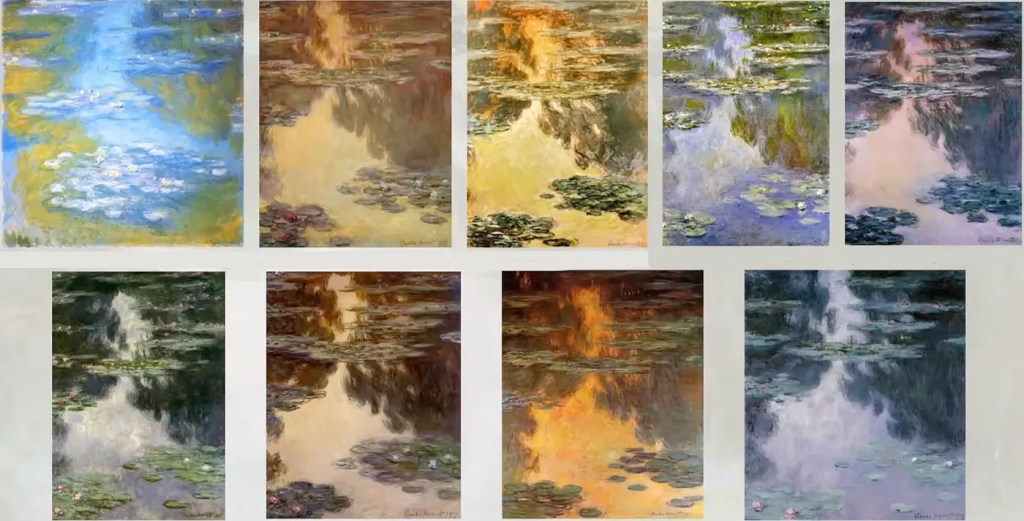
Conversely, the most publicly recognized and acclaimed of Monet’s works is the Nymphéas (Water Lilies) series. Monet’s Nymphéas is not a single painting but over 300 paintings created over three decades. For Monet, “[…] by painting a subject only once, was to deny one aspect of reality: the passage of time. Because one moment exists only in relation to others, an individual painting could not convey the ‘true and exact’ effect of the series as a group.” Before their first exhibition, Monet burned canvas and considered the rest “really not good enough to bother the public with.” It took years, and many entreaties from his dealer Paul Durand-Ruel, to exhibit them. In May 1909, Durand-Ruel prevailed, exhibiting a select few of the works in his gallery, eliciting a deluge of critical attention. The description by Jean-Louis Vaudoyer, a French novelist and art historian, captured their surreal essence.
Here, more than ever before, painting approaches music and poetry. There is in these paintings an inner beauty, refined and pervasive; the beauty of a play and of a concert, a beauty that is both plastic and ideal.
The extensive Nymphéas canvas, displayed at Musée de l’Orangerie since 1927, was Monet’s dream, which he relayed to Georges Clemenceau; “the still water reflecting the open blossoms” and “indefinite, deliciously vague tones with their dreamlike delicacy”. He wanted to create whole rooms of water lilies, rooms that would envelope people, projecting a sense of grace and beauty, as if they were with him at his pond. He recognized that he could not bring thousands of people to his garden. Nymphéas, therefore,are not Monet’s masterpiece, but portraits of it. Monet himself acknowledged, “It took me some time to understand my water lilies. … I cultivated them with no thought of painting them.” Cultivation preceded painting.
The tacit “inner beauty” defined by Vaudoyer is Monet’s true masterpiece: his garden. He created the garden through unprecedented feats in botany, engineering, and horticulture. Painting was Monet’s pursuit of encapsulating his masterpiece’s intoxicating, dynamic beauty. He explained such in a letter to Gustave Geffroy.
“No, I’m not a great painter. Neither am I a great poet. I only know that I do what I can to convey what I experience before nature and that most often, in order to succeed in conveying what I feel, I totally forget the most elementary rules of painting, if they exist that is.”
Monet moved into his Giverny estate in 1883. He began gardening immediately, drafting his wife, children, Octave Mirbeau, and Tadamasa Hayashi as helpers. For the 15 years that followed, Monet did not paint his garden — he waited until he perfected the world of flowers and the world of water.
My garden is a slow work, pursued with love and I do not deny that I am proud of it.
Claude Monet
The World of Flowers
No two days in the garden are the same: flowers wilt, bloom, and die with each passing moment. Atmospheric light conditions alter the entire landscape in a fleeting instant. Monet, well acquainted with light’s polymorphic qualities, planted many single-petaled flowers, like poppies (7 varieties worth) and daffodils; light permeates the petals gifting the effect of a stained glassed window. There are layers upon layers of color. On his house, potted and bedded plants mingle, trellises of yellow Mermaid rose line green shutters, and Virginia Creeper vines cling to the light pink stucco walls. In the garden, color extends into the sky; Monet planted tree roses and garnished arches with cascading roses.
This house and this garden, it is also a masterpiece, and Monet has put all his life into creating and perfecting it.
– Gustave Geffroy
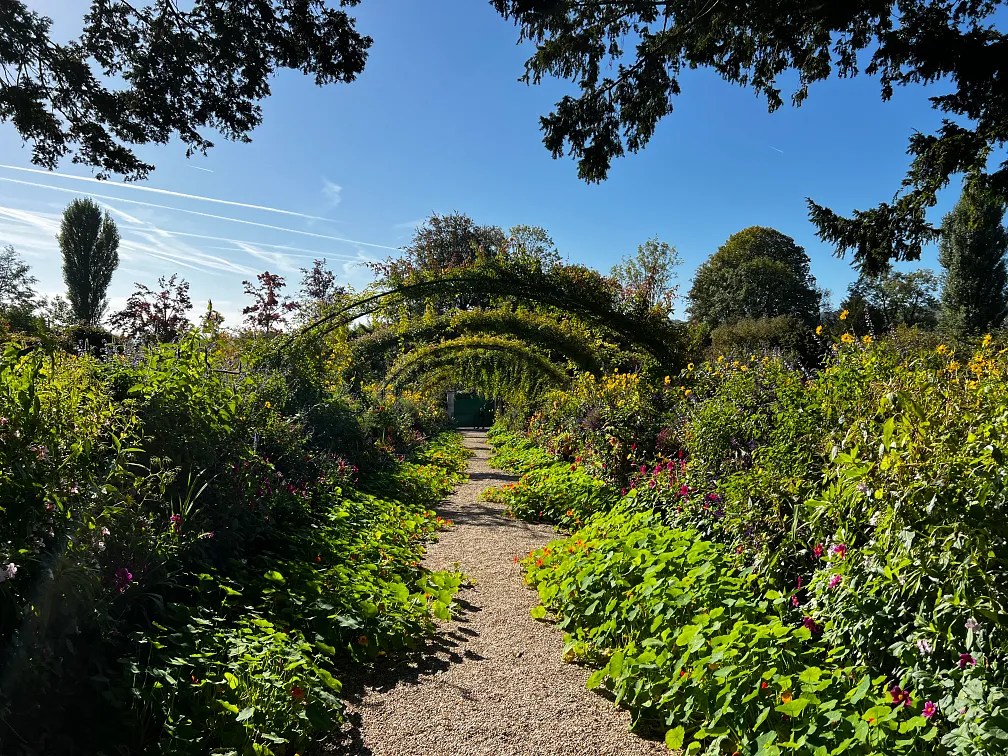
Each season has a distinct palette. Spring, the soft pinks of tulip and apple blossom. Summer, the deep purples of aubrieta and bearded iris lined pathways. Fall, the sharp yellows of tall black-eyed Susans and decaying Sycamore Maple leaves against the crisp blue sky. Green always has a home in Monet’s garden. There are more shades of green than there are names to give them. It is no wonder that this garden defined a new way for Monet to see, and paint, color, one which gave all succeeding artists a new visual vocabulary. Some of Monet’s compositions are, “so vibrantly colored that they elude a direct connection with nature and suggest pure sensory experience in its place.”
Having seen Claude Monet in his garden, one understands why such a gardener paints as he does.
-Maurice Khan
Monet grew wild and cultivated plants. He gathered seeds in the hills of Giverny. He collected seeds on his travels; on a trip to Italy, he tasted zucchini, brought back the seeds, and became the first individual to grow them in all of France. In the beginning, Monet did the gardening himself, but the garden slowly became unmanageable for one individual. At its peak, Monet spent 40,000 francs a year on plantings and upkeep and employed eight gardeners. Strict about upkeep, he wrote detailed instructions for when and where to plant seeds and how to prune shrubs, such as this, “From the 15th to the 25th, lay the dahlias down to root, plant out those with shoots before I get back… In March sow the grass seeds, plant out the little nasturtiums, keep a close eye on the gloxinia, orchids, etc., in the greenhouse, as well as the plants under frames.”
There is no happenstance in the arrangement of the flowerbeds, garden paths, lily pond, and footbridge than there is in the many striking color juxtapositions and broad brushstrokes in the canvases that depicted them.
Arsène Alexandre
Claude Monet, Shadow on the Lily Pond, c. 1920.
The world of water
In 1893, Monet purchased a plot of land bordering the Epte River (a tributary to the Seine) across the railroad track from his garden to fulfill his vision to create an Oriental floating garden. He was met with backlash from the residents of Giverny, as they argued his plants would poison their water. Writing to the prefect, Monet fought back:
The “cultivation of aquatic plants is not as significant as the term suggests and that it is merely intended for leisure and to delight the eye and also to provide motifs to paint. Finally, in this pond I will grow plants such as water lilies, reeds, and different varieties of irises which for the most part grow wild along our river, and there is thus no question of poisoning the water.”
He was granted permission later that year. Monet engineered his pond, installing two weirs (hand-controlled dams) at each end. These kept the pond from having a current — necessary to create the mirror-like stillness for his paintings — but allowed him to refresh the water as desired.
Water lilies were a part of the vision before the construction of the garden. At the 1889 World’s Fair in Paris, Joseph Bory Latour-Marliac’s water lily hybrids caught Monet’s eye. These hybrids were a feat of horticulture; Latour-Marliac crossed the now-extinct Laydekeri Floribunda hybrid with species and subspecies obtained from North America and elsewhere, resulting in yellow, fuchsia, and deep red water lilies. In 1894, Monet made his first order from Latour-Marliac, which included yellow and pink varieties. His paintings act as a record of the first non-white water lilies grown in Europe.
In 1895, Monet installed two curved Japanese footbridges. Instead of keeping it the traditional red, Monet painted the bridges green and draped them in white wisteria. Monet landscaped the water garden with inspiration from his collection of Japanese woodblock prints. He planted any plant seen on these prints; the pond is surrounded by Japanese apple, maple, quince, and cherry trees along with ginkgos, butterburs, azaleas, rhododendrons, wisterias, and bamboo.
At the time, Japonisme grew rampant across Europe, as Japan ended its isolationism in 1853. The simplicity, perspective, and asymmetricity of Japanese art found their way into the heart of the impressionist movement.
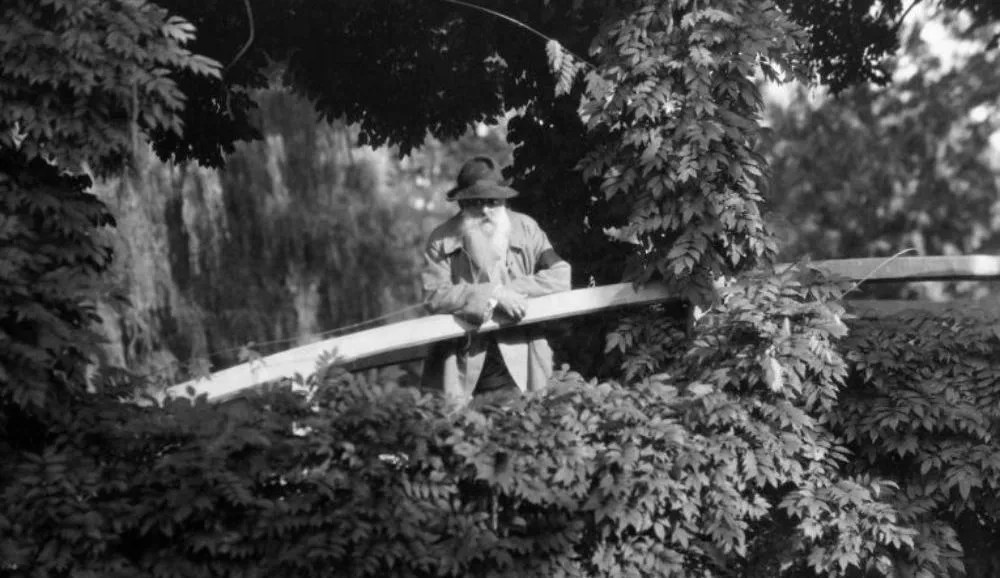
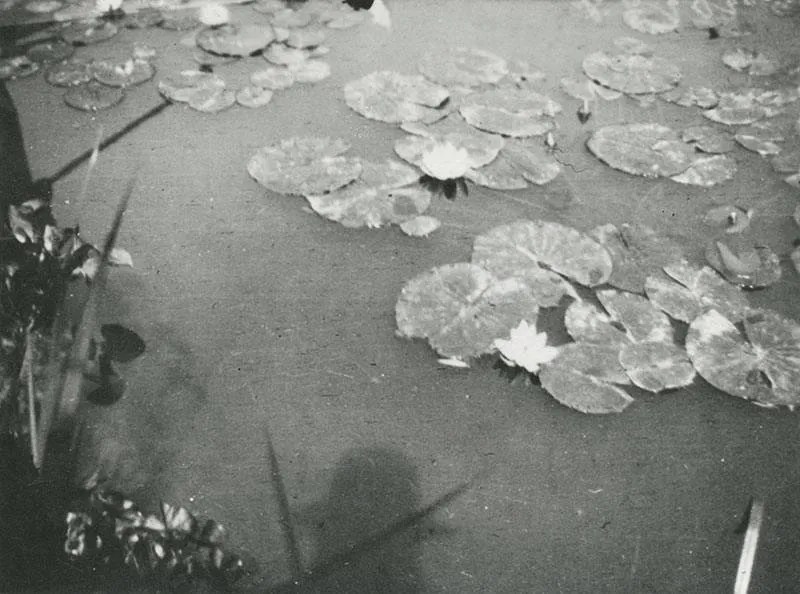
Monet kept the water’s surface clear of bugs, algae, and debris; one gardener’s job was to clear the surface of the pond each morning. The glass water surface, and the reflections it held, hypnotized Monet. Writing to Gustave Geffroy, he expressed this sentiment, “These landscapes of water and reflections have become an obsession. It’s quite beyond my powers at my age, and yet I want to succeed in expressing what I feel.”The obsession consumed Monet; focused on the watery world below him, he became the first Western painter to paint without a horizon line. This is evident in his self-portrait within the lily pond. Monet positions himself as if he was one of the lilies; he is his garden.
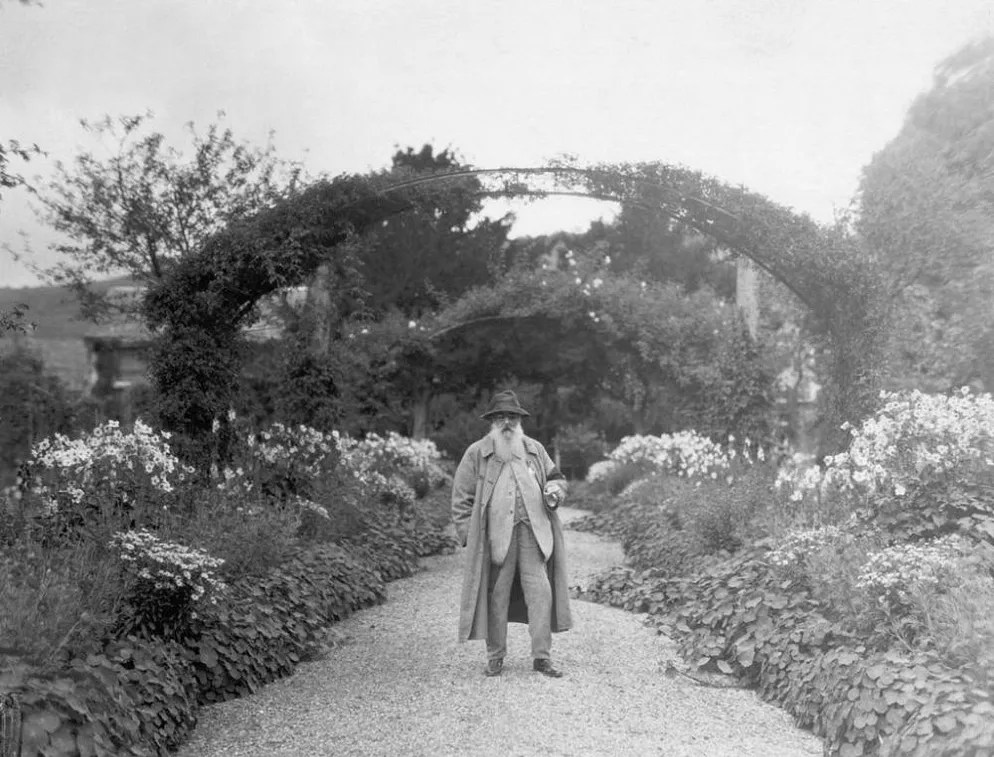
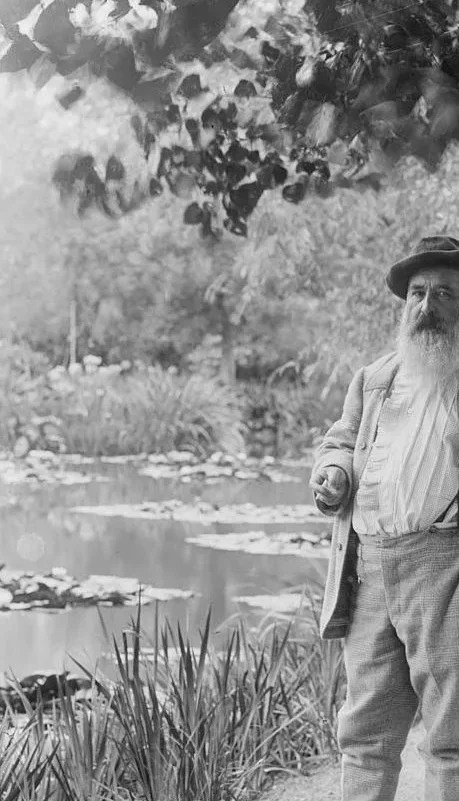
Monet’s water garden today (left) and Monet in his garden 1905
“My garden is my most beautiful masterpiece”
Unlike all other quotes used within the article, I could not identify the source of the above quotation although both the National Gallery of Art and the Royal Academy of Arts attribute it to Monet. If spoken, the quote justifies the garden as Monet’s greatest masterpiece.
Monet’s garden is arguably one of the greatest artistic masterpieces of all time, let alone his own. Amongst the flowers and footpaths, Monet painted the most recognized pieces of art in the world and redirected the fate of Western painting. Monet recognized that the master artist, though, is nature herself.
I have no other wish than to mingle more closely with nature, and to live in harmony with her laws. […] Nature is greatness, power, and immortality; compared with her, a creature is nothing, an atom.
2: Screenshot from lecture with John Wiersema Ph.D. (below)
3 (left): “Claude Monet’s Studio and Garden at Giverny in Stunning Photographs, 1900–1920s.” Rare Historical Photos, 4 July 2023, rarehistoricalphotos.com/claude-monet-studio-photos/.
4: Iles, Chrissie. “The Shadow of the Gaze.” ArtButler, files.artbutler.com/file/3247/bf279ddb769d48b8.pdf.
References
Books
Kendall, Richard, and Bridget Strevens Romer. Monet by Himself ; Paintings, Drawings, Pastels, Letters. Time Warner Books, 2004.
Wildenstein, Daniel, and Claude Monet. Monet or the Triumph of Impressionism. Taschen, 2003.
Russell, Vivian. Monet’s Garden: Through the Seasons at Giverny. Frances Lincoln UK, 2016.
Wildenstein, Daniel, and Claude Monet. Monet’s Years at Giverny: Beyond Impressionism. The Metropolitan Museum of Art, 1978.
Daneo, Angelica, et al. Claude Monet: The Truth of Nature. Prestel, 2019.
Lectures
“Botanical Briefing: Monet’s Passion: Ideas, Insights and Inspiration from the Painter’s Gardens.” Lecture Series with Elizabeth Murray, Marie Selby Botanical Gardens, 12 Mar. 2021, https://www.youtube.com/watch?v=ZqmsBfDjbM0.
“Botanical Briefing: A Taxonomist’s View on the Essence of Waterlilies That Inspired Claude Monet.” Lecture Series with John Wiersema, Ph.D., Marie Selby Botanical Gardens, 19 May 2021, https://www.youtube.com/watch?v=gxlJQwp0N-U.
Tham, Bee. “Claude Monet: The Visionary, the Painter, and the Gardener.” Missouri Botanical Garden, 15 Sept. 2020, discoverandshare.org/2020/09/15/claude-monet-the-visionary-the-painter-and-the-gardener/.

 Maya Ordoñez